ADIP Scheme
Assistance to Disabled Persons for Aids and Appliances
The ADIP Scheme is a Government of India scheme that gives free or cheap aids and appliances to persons with disabilities who cannot afford them. These include artificial limbs, callipers, wheelchairs, tricycles, hearing aids, smart canes and cochlear implants. The aim is to help people move, hear, see, study and earn on their own. It is run by the Department of Empowerment of Persons with Disabilities (DEPwD) under the Ministry of Social Justice and Empowerment.
Why does it exist?
A good artificial leg, a motorised tricycle or a hearing aid can change a person's life. With it, a farmer who lost a leg can walk to his field again, and a deaf child can go to a normal school. But many such devices cost thousands of rupees, which poor families cannot pay. Without help, the person stays at home, depends on others, and may even develop further health problems. The ADIP scheme pays for these aids so that cost is not a barrier.
What is its constitutional base?
- Article 41 (a Directive Principle of State Policy) asks the State to provide public assistance in cases of disablement, within its economic capacity.
- "Relief of the disabled and unemployable" is Entry 9 of the State List, but the Centre runs this scheme to support the states.
- The RPwD Act, 2016 requires governments to provide aids and appliances and rehabilitation.
Where did it come from?
- The scheme has been running since 1981, which the UN marked as the International Year of Disabled Persons.
- It was revised several times. Recent revisions came into effect on 1 April 2022 and 1 April 2024.
- In March 2024, the UDID card (Unique Disability ID) was made mandatory for getting aids, and smartphones and tablets were added as aids for people with hearing impairment.
- The scheme was approved for the 15th Finance Commission period, up to 31 March 2026.
Who is eligible?
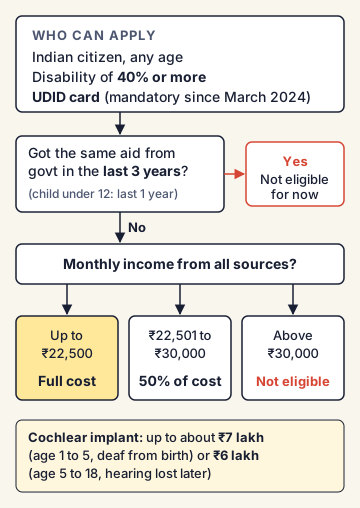
- An Indian citizen of any age with a disability certificate of 40% or more (benchmark disability).
- Monthly income from all sources of up to ₹30,000.
- The person should not have received the same aid in the last 3 years from any government source. For children below 12, this gap is 1 year, because children outgrow their aids quickly.
How much help is given?
- Income up to ₹22,500 a month: the full cost of the aid is paid.
- Income from ₹22,501 to ₹30,000 a month: 50% of the cost is paid.
- Full help is given for aids costing up to ₹15,000; for costlier aids, the help is capped, with special higher limits for some items.
- Cochlear implants (a small electronic device placed by surgery that helps a deaf child hear): the government pays up to about ₹7 lakh per child for children aged 1 to 5 with hearing loss from birth, and ₹6 lakh for children aged 5 to 18 who lost hearing later. This covers the device, surgery, therapy and travel.
- Where needed, corrective surgery is also paid for before fitting an aid.
How does it work, step by step?
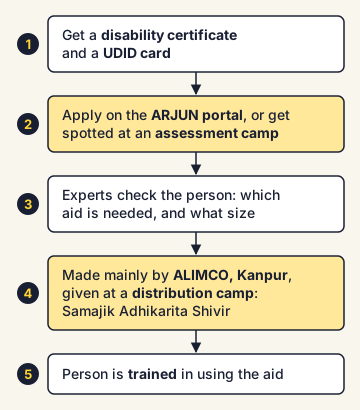
- The person gets a disability certificate and a UDID card.
- They apply online through the ARJUN portal (ADIP and RVY Joint Interface for Unique Nomination), or are identified at an assessment camp.
- Experts check the person and decide which aid they need and its size.
- Aids are made or bought and given out at distribution camps, often called Samajik Adhikarita Shivirs, held with district administrations.
- The person is trained in using the aid.
Who implements it?
The Ministry gives grants to implementing agencies:
- ALIMCO (Artificial Limbs Manufacturing Corporation of India), Kanpur: incorporated on 30 November 1972 as a not-for-profit company (now under Section 8 of the Companies Act, 2013). It is a Mini-Ratna (Category II) public sector enterprise and the main maker and supplier of aids under ADIP.
- National Institutes for different disabilities and Composite Regional Centres (CRCs).
- District Disability Rehabilitation Centres, State Disability Corporations and registered NGOs.
India's position and related schemes
- Rashtriya Vayoshri Yojana (RVY): a separate scheme, launched in 2017, that gives free aids like walking sticks, hearing aids and spectacles to senior citizens with age-related problems. It is also implemented through ALIMCO.
- Accessible India Campaign (Sugamya Bharat Abhiyan, 2015): makes buildings, transport and websites accessible.
- The word "Divyangjan" is now used officially for persons with disabilities, and the scheme's name has been updated in recent years to reflect this.
Commonly confused concepts
- ADIP vs RVY: ADIP is for persons with disabilities (40% or more, any age). RVY is for senior citizens with age-related problems.
- Disability certificate vs UDID card: The certificate states the type and percentage of disability. The UDID card is a single national ID for persons with disabilities that works across India and is now needed for ADIP.
- Benchmark disability (40%) vs high support needs: 40% is the minimum for most benefits. Some benefits, like motorised tricycles, are for people with more severe disability.
- ADIP vs NSAP disability pension: ADIP gives devices. The Indira Gandhi National Disability Pension under NSAP gives monthly cash to poor persons with severe disabilities.
Issues, criticism and the way forward
- Quality and fit: Users sometimes complain that aids are heavy, do not fit well, or break soon. Good follow-up and repair services are often missing in villages.
- Reach: Many eligible people, especially in remote tribal areas, do not know about the scheme or cannot travel to camps.
- Paperwork: Making the UDID card mandatory improves targeting, but people without it may be left out until they get one.
- Modern devices: Experts suggest adding more advanced aids (like lighter prosthetics and digital devices) and regular updating of cost limits.
- Way forward: Doorstep assessment camps in remote areas, tie-ups with district hospitals for follow-up, and linking with skill and job schemes so the aid leads to independent living.
Concepts to Know
- Assistive device (aid or appliance): Any tool that helps a person with a disability do daily tasks, such as an artificial limb, wheelchair or hearing aid.
- Prosthesis: An artificial body part, such as an artificial leg or hand. An orthosis (like a calliper or brace) supports a weak body part instead.
- Locomotor disability: A problem in moving the body or limbs, for example after losing a leg.
- Directive Principles of State Policy: Guidelines in Part IV of the Constitution that the government should follow while making laws, though courts cannot enforce them directly.
- Mini-Ratna: A status given to well-performing public sector companies, which gives them more freedom to take financial decisions.
- ADIP running since 1981; implemented by DEPwD, Ministry of Social Justice and Empowerment
- Eligibility: Indian citizen, 40% or more disability, income up to ₹30,000 a month, no same aid in last 3 years (1 year for children below 12)
- Full cost paid if income up to ₹22,500 a month; 50% if ₹22,501 to ₹30,000
- Cochlear implant support: about ₹7 lakh (children 1 to 5 with hearing loss from birth); ₹6 lakh (5 to 18, acquired loss)
- UDID card mandatory since March 2024; applications on the ARJUN portal
- ALIMCO: Kanpur, incorporated 30 November 1972, Section 8 company, Mini-Ratna Category II CPSE
- Constitutional base: Article 41 (DPSP); State List Entry 9
● Tracked since October 15, 2026 · last seen October 15, 2026 · updates as the daily brief publishes